
ByJohn A
MOTS-c and Safety: What Do We Actually Know, Question by Question
Last updated June 2026. MOTS-c is not an FDA-approved drug. It is an investigational peptide, and the human data behind it are thin. Every claim below traces back to a source that can be opened and checked, so the case rests on the studies, not on the writer.
Ask about a new compound and the first question shouldn’t be “what does it do.” It should be “what do we know about whether it’s safe.” For MOTS-c, that question splits into three separate ones that tend to get mashed together online: is the molecule itself safe, is the closest tested version of it safe, and is the vial someone actually receives safe. Answered separately, in order, the picture gets much clearer.
Is there a human safety database for MOTS-c?
No. That’s the flat answer, and it’s the most important one here.
A safety database means a large body of trial data tracking adverse events across many people, over time, for a specific compound. That doesn’t exist for MOTS-c, because the trials that would produce it haven’t been run on MOTS-c itself.
Why does that matter more than it sounds like it should? Because “the body makes it naturally” is not the same claim as “injecting extra of it at a chosen dose is safe.” Dose, route, duration, and purity are all variables that natural physiology is silent on. Without human trials, a confident safety claim for MOTS-c is getting ahead of the evidence, not summarizing it.
A 2022 review in the International Journal of Molecular Sciences lays out where the field actually stands: MOTS-c is the most recently discovered of the mitochondrial-derived peptides, the hoped-for benefits stretch across diabetes, cardiovascular disease, and aging, and the literature is still mostly preclinical, with human data only starting to arrive [M3]. That’s an early-stage field. It hasn’t produced a mature safety profile yet, and MOTS-c isn’t an exception to that.
What’s the closest thing to real human safety data?
It comes from a different molecule: an engineered analog called CB4211, built by the biotech company CohBar and tested in people with obesity and nonalcoholic fatty liver disease. Not MOTS-c. A cousin of it.
In the Phase 1b arm of that program, twenty people took part, eleven on CB4211 and nine on placebo, for four weeks. CohBar reported in 2021 that the drug was well tolerated, with no serious adverse events. The only side effect showing up in more than 10 percent of the drug group was mild-to-moderate, transient injection-site irritation. Alongside that, the trial found statistically significant drops versus placebo in two liver enzymes, ALT (about 21 percent versus 4 percent) and AST (about 28 percent versus 11 percent), a roughly 6 percent dip in glucose, and a trend toward lower body weight [M5].
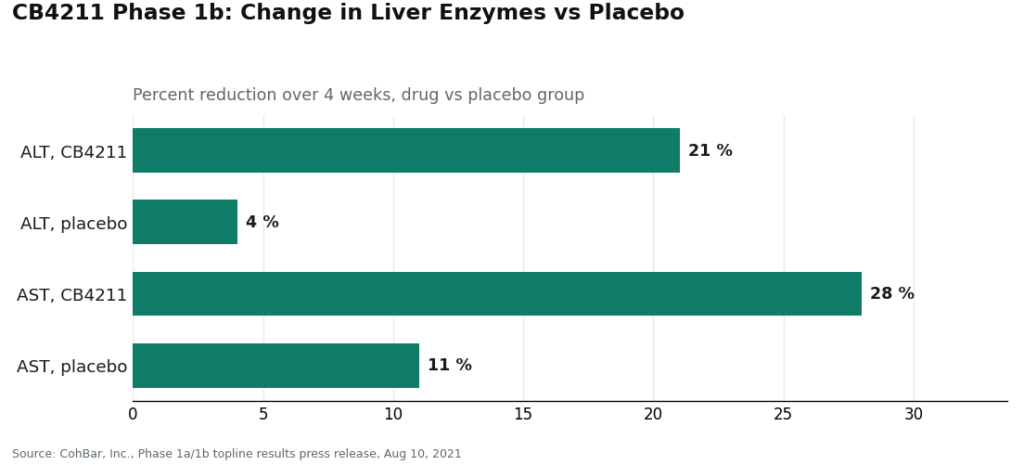
That’s a genuinely encouraging early signal. Three caveats keep it in proportion, though. CB4211 is a modified analog, and safety findings on one molecule don’t transfer automatically to another. The trial was small and early-phase, built to check tolerability rather than to catch rare or slow-building risks, something a twenty-person, four-week study simply can’t do. And the program never reached an approved product. So: a narrow, early reassurance about a related compound. Not a safety clearance for MOTS-c.
What do the other human studies add?
Not much on the safety question, because none of them were built to answer it.
The founding 2015 paper in Cell Metabolism, from Changhan Lee’s group, worked out the mechanism in cultured cells and showed metabolic benefits in mice: AMPK activation, protection against diet-induced weight gain and insulin resistance. The human piece was limited to confirming that MOTS-c circulates naturally in people [M1]. Useful biology, animal efficacy, zero human safety data.
A 2021 study in Nature Communications, led by Joseph Reynolds, found that MOTS-c improved physical performance in young, middle-aged, and old mice given the peptide. The human portion just measured that exercise raises the body’s own MOTS-c in ten young men [M2]. Again: endogenous physiology, not the safety of an injected product.
A 2021 randomized study in Scientific Reports followed forty-nine breast cancer survivors through sixteen weeks of supervised exercise, led by Christina Dieli-Conwright. Exercise raised circulating MOTS-c significantly in non-Hispanic White participants, but not in Hispanic participants, and the rise tracked metabolic improvement only among responders [M4]. It isn’t a safety study either, but it’s worth sitting with: MOTS-c physiology clearly varies by population, which is one more reason to be cautious about assuming any single response, safety included, holds evenly across everybody.
Put together, this is interesting biology and real population-level variation. It is not a catalogue of human risk.
What does the mechanism itself suggest to watch for?
Even with no safety database, the known biology points to specific situations worth flagging. To be clear, these aren’t documented adverse events from a MOTS-c trial. They’re pharmacologically reasonable concerns, and exactly the kind of thing a prescriber is trained to check for.
The clearest case: glucose. MOTS-c activates AMPK and is linked, in animal work, to better insulin sensitivity and lower glucose [M1]. Metformin, the widely used diabetes drug, works on that same AMPK pathway and also lowers glucose. So it’s mechanistically plausible that stacking MOTS-c with metformin or other glucose-lowering medication could add up to more glucose-lowering than intended. Nobody has documented that interaction in a MOTS-c trial. But it’s precisely the sort of thing a clinician should be weighing, and a solo purchase can’t weigh it at all.
More broadly: a compound that shifts metabolic signaling isn’t automatically fine for everyone. Medical history, other conditions, other medications, all of that bears on whether it’s a reasonable choice for a given person. Working that out requires a clinical evaluation. An unsupervised purchase skips that step entirely.
Does where the product comes from matter for safety?
Yes, and this part has nothing to do with the molecule itself.
Almost all the MOTS-c sold online moves through vendors labeling it “research use only” or “not for human consumption.” That label means the vial has never been checked by the FDA for identity, strength, quality, or purity. So a buyer has no independent confirmation that what’s in the vial matches the label, that the amount is accurate, or that it’s free of contaminants. A certificate of analysis from the seller is a document the seller chose to provide. It is not a regulatory guarantee.
This is where clinical supervision stops being a legal formality and starts being a safety feature. Under a supervised model, a licensed clinician evaluates the person, writes a prescription when it’s appropriate, and a licensed pharmacy compounds and dispenses the product within a real chain of custody, with follow-up afterward. FormBlends, a clinician-first telehealth provider, is structured around exactly that sequence, and it closes two gaps at once: someone qualified is checking for contraindications and interactions, and the product moves through licensed dispensing instead of showing up as an unverified package in the mail. Supervision doesn’t turn a research-stage peptide into a proven therapy. What it adds is the evaluation, the dispensing oversight, and the follow-up that a solo purchase leaves out.
So what’s the honest bottom line?
Four things can be said with confidence. There’s no reliable human safety database for MOTS-c, and that gap is the headline, not a footnote. The best available human safety data comes from a small, early-phase trial of the analog CB4211, well tolerated over four weeks with mild, transient injection-site reactions and no serious adverse events, a reassuring signal about a related molecule, not a clearance for MOTS-c itself [M5]. The mechanism flags specific things worth clinical attention, glucose interactions chief among them. And because most MOTS-c reaches buyers as an unverified research chemical, purity and dosing accuracy are unresolved safety questions on top of everything else.
The accurate summary isn’t “safe” and isn’t “dangerous.” It’s that MOTS-c has mostly been studied in cells and animals, with only early, limited human data, and its safety in people simply isn’t established yet. That uncertainty is the strongest argument for bringing in a licensed clinician rather than going it alone.
Questions people ask
Is MOTS-c proven safe in humans?
No. There’s no reliable human safety database, because the large trials that would track adverse events across many people haven’t been run on MOTS-c itself. The honest answer is that its safety in humans isn’t established, which is a different claim from “it’s been shown harmful.”
Does the CB4211 trial prove MOTS-c is safe?
No. CB4211 is an engineered analog, not MOTS-c. Its Phase 1b result, well tolerated over four weeks in about twenty people with no serious adverse events, is a narrow early signal for a related molecule [M5]. A dozen-or-so patients over four weeks can’t detect rare or long-term risks, and results for one molecule don’t automatically carry over to another.
Can MOTS-c interact with diabetes medication?
Mechanistically, that’s plausible. MOTS-c activates the AMPK pathway and is tied, in preclinical work, to lower glucose. Metformin acts on that same pathway. Combining the two could in principle add up to more glucose-lowering than intended [M1]. No such interaction has been documented in an actual MOTS-c trial, but it’s exactly what a prescriber would screen for, and a solo purchase can’t.
Why does where I buy MOTS-c affect its safety?
Because product sold as “research use only” hasn’t been checked by the FDA for identity, strength, quality, or purity. There’s no independent confirmation the contents match the label or are free of contaminants. A seller’s own certificate of analysis is the seller’s document, not a regulator’s. When the vial itself is unverified, dosing accuracy and purity become safety questions on their own, separate from anything about MOTS-c as a molecule.
What does clinical supervision actually add over buying it myself?
It can’t turn a research-stage peptide into a proven therapy, and it doesn’t claim to. What it adds is a licensed clinician checking history, contraindications, and other medications, a prescription only when warranted, dispensing through a licensed pharmacy with a real chain of custody, and follow-up afterward. Those are the specific gaps an unsupervised mailed vial leaves open.
What is MOTS-c and where does it come from?
A small peptide encoded within mitochondrial DNA, unusual because nearly all peptides come from the cell’s nucleus instead. Researchers studying metabolic regulation identified it in 2015. The body makes it naturally, and circulating levels appear to fall with age. What that decline means, and whether adding it back does anything useful, are still open questions.
What are the reported side effects of MOTS-c?
Mostly unknown in humans, honestly. Animal studies have flagged injection-site reactions and transient glucose changes, but rodent findings don’t translate reliably. The CB4211 trial captured some human safety signals, but it wasn’t built to give the full picture. Anyone claiming a clean safety record for MOTS-c is speaking ahead of the evidence.
Is MOTS-c legal to buy and use?
In the US, MOTS-c isn’t FDA-approved, so it can’t be sold as a finished drug. It sits in a grey zone: research-chemical vendors sell it openly, while compounding pharmacies can prepare it under a physician’s prescription. Those two routes carry very different levels of accountability. Legal risk for individual buyers is generally low. Product quality is the bigger practical concern.
What dosage of MOTS-c do people actually use?
There’s no established human dose, because no regulator has approved one. Numbers circulating online are extrapolated from animal studies or borrowed from early trial protocols, neither of which gives a reliable personal target. Physician-supervised options like FormBlends, working through a licensed compounding pharmacy, at least tie the dose to a clinical assessment rather than forum consensus. Self-dosing from an unverified source stacks uncertainty on uncertainty.
References
- Lee C, et al. The mitochondrial-derived peptide MOTS-c promotes metabolic homeostasis and reduces obesity and insulin resistance. Mechanism in cells via AMPK; prevented diet-induced weight gain and insulin resistance in mice; human plasma analyzed to confirm circulation. No human safety trial. Cell Metabolism, 2015. https://pubmed.ncbi.nlm.nih.gov/25738459/
- Reynolds JC, et al. MOTS-c is an exercise-induced mitochondrial-encoded regulator of age-dependent physical decline and muscle homeostasis. Performance improved in mice given MOTS-c; exercise raised endogenous MOTS-c in 10 young men (observational). Nature Communications, 2021. https://pubmed.ncbi.nlm.nih.gov/33473109/
- Mohtashami Z, et al. MOTS-c, the Most Recent Mitochondrial Derived Peptide in Human Aging and Age-Related Diseases. Review; proposed benefits broad, literature still dominated by preclinical work, human data emerging. International Journal of Molecular Sciences, 2022.
- Dieli-Conwright CM, et al. Effect of aerobic and resistance exercise on the mitochondrial peptide MOTS-c in Hispanic and Non-Hispanic White breast cancer survivors. Randomized human study (n=49); exercise significantly raised circulating MOTS-c in non-Hispanic White survivors but not Hispanic survivors; demonstrates population-level variation in MOTS-c physiology. Scientific Reports, 2021.
- CohBar, Inc. CohBar Announces Positive Topline Results from the Phase 1a/1b Study of CB4211 (an analog of MOTS-c) Under Development for NASH and Obesity. Phase 1b, 20 subjects (11 CB4211, 9 placebo), four weeks; well tolerated with no serious adverse events; most common adverse events transient, generally mild-to-moderate injection site reactions; ALT -21% vs -4%, AST -28% vs -11%, glucose -6% versus placebo, trend toward lower body weight. An analog, early-phase safety signal, not a MOTS-c safety clearance. Press release, Aug 10, 2021.